Why this blog exists
I knew nothing. Then I watched a YouTube video saying you can make money with WordPress and Google AdSense. Every video ended the same way: buy an expensive course. I did not want to do that. So I built an AI secretary instead.
What I wanted to read was a record written by someone actually trying to make the money — not someone selling the method. I could not find one anywhere. So I decided to write it myself. This blog documents my AdSense experiment step by step, and I am publishing everything: the numbers, the failures, all of it. Full disclosure up front: I have not earned a single dollar from this yet. This is not a course. It is an experiment log with receipts.
Problem one: gaming is the only thing I can do on a computer
I hit a wall immediately. Forget coding — gaming is about the only thing I know how to do on a computer. I did not know what WordPress was, what a domain was, or what AdSense approval involved.
I needed a partner for this goal, and I do not have the budget to hire a person. So my first project defined itself: build my own AI secretary agent.
Which AI should build my secretary? Comparing the three I knew
To build a secretary, I first had to pick the AI. There are supposedly many, but the only names I knew were Gemini, ChatGPT, and Claude. So I spent a few days trying all three at a total beginner’s level. I cannot read benchmark scores, so my test was a single question: can a person who only knows gaming hand this thing real work?
| What I compared | Gemini | ChatGPT | Claude |
|---|---|---|---|
| First impression | Handy — lives next to Google search | The famous one, safe choice | The least famous of the three |
| Conversation quality | Fast but sometimes skims the surface | Friendly and smooth | Careful, and willing to disagree |
| Can I hand it actual work? | Mostly search and summaries | Chat-first, limited execution | Agent mode operates my browser and builds files |
| Remembers my standing rules | Limited | Custom instructions exist | Keeps project-level rules and documents |
(This comparison is one beginner’s personal impression from a few days in July 2026, before paying for anything. These services change constantly — treat it as a snapshot, not a verdict.)
Why I picked Claude
Two things decided it.
First, it does not just talk — it has hands. Claude’s agent mode operates my actual browser: it opens signup screens, changes settings, creates files. The other two mostly told me “here is how you do it.” Claude was closer to “I will do it — you just handle the payment.” For someone who only knows gaming, that difference was everything.
Second, it pushes back. As a test I pitched all three a half-baked business idea. Only Claude led with the failure factors of my approach. I had no use for a yes-man secretary.
I expected plenty of trial and error early on. The free tier clearly was not going to carry this project. So I stretched and bought the Claude Max subscription at $100 a month — the biggest fixed cost in this project. Making that money not feel wasted is part of the experiment.
Building my AI secretary
Having paid for the expensive subscription, I went ahead and built the secretary on the newest model (fable5).
Then came the embarrassing problem. What I want is “make money with AdSense” — but I did not know what to do, how to do it, or honestly even what exactly I wanted. A goal with no contents.
So I flipped the approach. Before giving my AI secretary any work, I wrote rules for how it should treat me. This is close to the full text of my project instructions:

- If my question is vague or missing information, do not guess — ask me for the specific detail first.
- If my idea has a hole in it, say so politely but plainly. No sugarcoating, no rudeness.
- No excessive optimism or pessimism when advising. State it neutrally: “the success condition is A, the failure factor is B.”
- For strategic decisions, present both an aggressive option and a conservative option, then name your recommendation and why.
- Every report starts with a three-line summary of the conclusion. No filler, no both-sides hedging, no unnecessary disclaimers.
- Apply four criteria to every business judgment: interference with my day job, revenue per hour, scalability and automation potential, regulatory and reputation risk.
- For anything involving markets or regulation, check current information on the web before answering.
That became the standing project instruction set, and with it, the secretary was born.
What those rules actually did
I found out on day one that these rules are not decoration. When I said “let’s build an AdSense monetization model,” the secretary did not start working — it first asked what exactly I wanted to make (rule 1). When I pitched my “total beginner makes money” concept, it flagged the risk in that framing and proposed a different angle (rule 2 — full story in the next log). When strategy came up, it laid out an aggressive option and a conservative option side by side and named its pick. And every report opened with a three-line conclusion, which turned half-day decisions into five-minute ones.
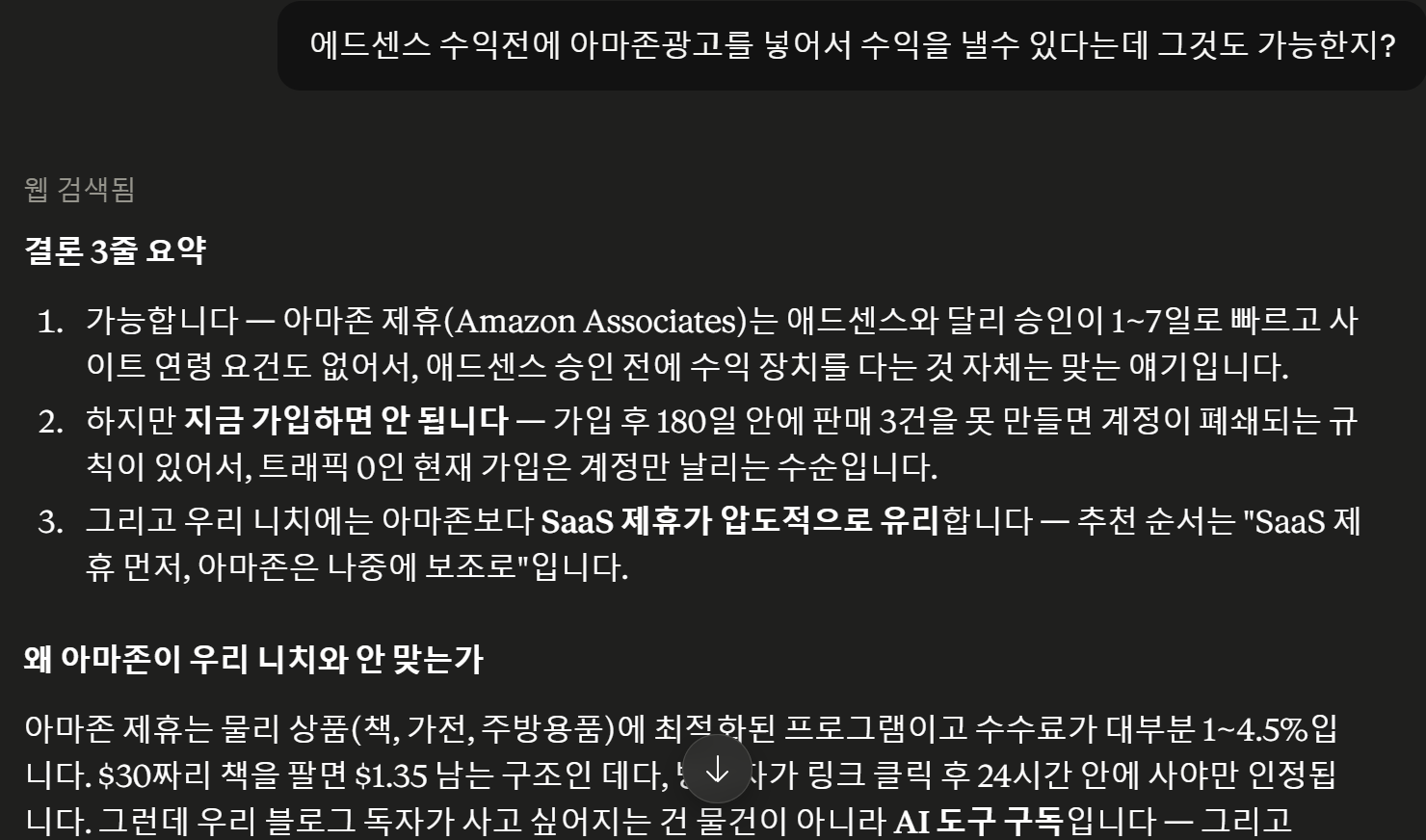
One line summary: the rules did not make the secretary smarter. They made me capable of deciding.
Steal the rules — copying this costs nothing
Here is the part no paid course will tell you: everything in this post is free to copy. The seven rules above are not proprietary. Paste them into the custom-instruction or project-instruction box of whatever AI you already use, adjust the four business criteria to your own situation, and you have the same secretary I have — at least the thinking part of it.
To be clear about what actually costs money: the reasoning, the pushback, the three-line reports — the free tiers of all three services can do that. What I am paying $100 a month for is the execution layer: an agent that operates the browser, builds files, and works for long stretches without me. If you just want a sparring partner that stops you from making dumb decisions, start free. Upgrade when the bottleneck becomes your own hands, not the AI’s brain. That was my logic, and whether it was the right call is exactly what the coming logs will show — in numbers.
One warning from my first week, though: a secretary is only as useful as the rules you give it. The default behavior of every AI I tried is agreeable and vague — pleasant, and useless for business decisions. The single highest-leverage hour of my Day 1 was not picking the AI. It was writing down, in plain sentences, how I wanted to be disagreed with.
AdSense Project — Day 1 Closing
| Revenue | $0 |
| Spend — Claude Max subscription (recurs monthly) | $100 |
| Net | -$100 |
| My hands-on time | About 2 hours — choosing the AI, writing the rules, paying |
| What Day 1 produced | One AI secretary that talks back |
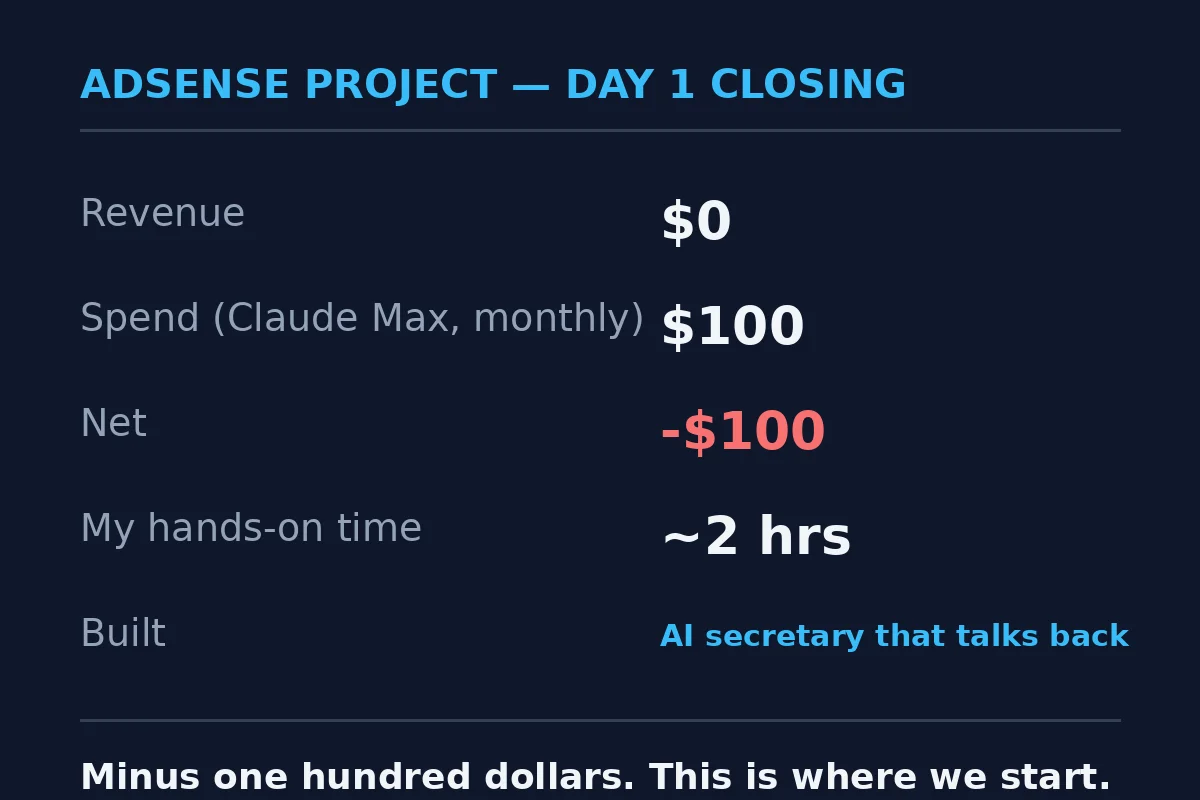
Minus one hundred dollars. This is where we start.
Build Log #2 preview: this secretary built this entire blog in one evening — receipts included.
The story continues:
👉 Build Log #2 — Can an AI Build a Website? Mine Did, in One Evening
👉 The Real Cost to Start a Blog With AI in 2026 (Receipts Included)